June 17th, 2026

Overview
This week, we discuss major Chinese Naval buildup, Xi's visit to North K0rea, and changes in China's outbound direct investment.
Defense
China Unveils New Warship Amid Surge in Naval Buildup
By Contributor Mitran Kumar
On May 31st, Chinese state media confirmed the commissioning of the Tongchuan, a new Type 052D guided-missile destroyer, the latest addition to an increasingly visible buildup of the Chinese Navy.

Chinese Type 052D Destroyer in port. (via. MSN)
Commissioning: On May 31st, CCTV Military aired footage of the destroyer Tongchuan, bearing hull number 177, confirming its entry into service with the 9th Destroyer Flotilla of the Southern Theater Navy. The vessel belongs to the improved Type 052DL subclass, which features a roughly four-meter hull extension and a larger flight deck able to operate the Harbin Z-20F naval helicopter. Displacing approximately 7,500 tons, the destroyer carries a 64-cell vertical launch system capable of deploying HHQ-9B long-range surface-to-air missiles, YJ-18 anti-ship cruise missiles, and CJ-10 land-attack cruise missiles, paired with an active electronically scanned array radar suite. Chinese state messaging emphasized that the warship was “independently researched and designed,” framing the commissioning as much as a statement of domestic industrial capability as a military milestone.
Recent Buildups: The Tongchuan is the 35th Type 052D-series warship to enter service since the class debuted in 2014, which together with the People’s Liberation Army Navy’s (PLAN) Type 055 large destroyers gives the force around 45 latest-generation destroyers. The commissioning is only one marker of a broader surge. In the same window, satellite imagery captured on May 31st and June 1st revealed a previously unreported submarine at the JN shipyard in Shanghai, a roughly 120-meter boat notable for its futuristic “sailless” design, with analysts assessing that a sister vessel may have launched simultaneously at the nuclear-only Huludao shipyard. Such activity fits a sustained pattern: China has launched an estimated 15 to 20 submarines across at least eight new classes over the past five years, while its shipyards have produced surface combatants at a rate of six to ten destroyers annually—nearly double the American pace over the same period.
Broader Implications: China now fields the world’s largest navy by hull count, with more than 370 ships and submarines, including three aircraft carriers, and the pace of its expansion is increasingly viewed in Washington as a strategic concern. U.S. defense officials and recent Pentagon assessments have repeatedly flagged Beijing’s shipbuilding capacity as one of its most significant advantages in a potential high-intensity conflict, even as the U.S. Navy retains edges in radar performance, integrated missile defense, and decades of operational experience. For Beijing, a larger and more modern fleet enables persistent patrols in the South China Sea, expanded operations around Taiwan, and the ability to escort carrier strike groups and contest the undersea domain across the Western Pacific. As the buildup grows more visible, it is increasingly felt by regional neighbors and Western navies alike, sharpening the competition between American technological superiority and Chinese production capacity that is steadily reshaping the balance of power in the Indo-Pacific.
Diplomacy
They Xi Me Rolling! : Xi Jinping Concludes Trip to North Korea
By Contributor Henry Pandamadi
On the 9th of June, Xi Jinping concluded his first visit to North Korea since 2019. Although no specific deal was signed between the two parties, this visit was a symbolic one, seen as a way of bringing both nations closer together.
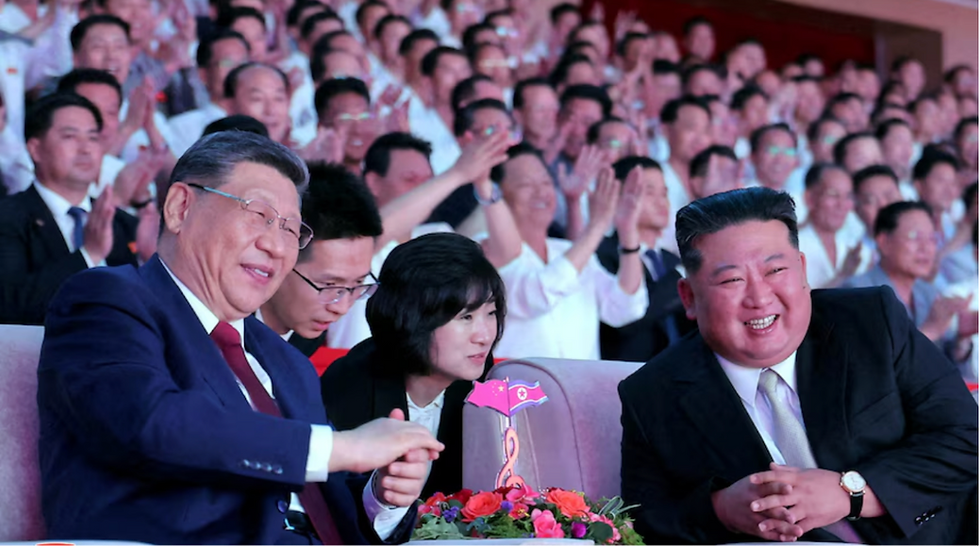
Xi Jinping (left) and Kim Jong-Un (right) spectating on an indoor musical performance in the Pyongyang Indoor Stadium (via Reuters: Korean Central News Agency)
The Red Carpet: It seems that Kim Jong-Un pulled out all the stops for the Presidential visit. Not only was Xi and his wife housed in the exclusive and luxurious Kumsusan Guesthouse, built for his previous visit in 2019, but Xi also met with cheering crowds and saw his face plastered on billboards across the capital. This visit was especially noticeable because China often hosts bilateral talks on home soil. In fact, last year, Xi only travelled abroad four times. Therefore, making the trip to Pyongyang emphasises China’s commitment to the Democratic People’s Republic of Korea and, by extension, its leadership.
Moscow’s Mouthpiece?: Although lauding their “unbreakable friendship”, Xi may have initiated this visit as a gentle reminder to Pyongyang of its priorities. Indeed, amidst the ongoing Russo-Ukrainian war, Pyongyang has continued and even deepened bilateral ties with Putin’s Russia, via, for example, a defence treaty signed in June 2024. As part of this deal, Russia is set to significantly increase trade with North Korea, aiding its ailing economy. While China’s alliance with the Hermit Kingdom is reminiscent of past victories, Russia’s ties are seen as more contemporary and perhaps more tangible, exemplified by the more than 10 000 North Korean soldiers currently fighting on the Russian frontline.
Spheres of Influence: Equally important to Beijing is the maintenance of its influence in Asia and around the globe. In regards to Asia, ensuring that Kim Jong Un and the accompanying nuclear arsenal of the DPRK are under control is a key aspect of Chinese foreign policy. Across the border in South Korea, China has attempted to placate South Korean concern regarding the North’s missile tests. Further afield in Japan, China has condemned their “new militarism”, after prime minister Sanae Takaichi named North Korea as a reason behind recent Japanese attempts to bolster the nation’s armed forces. Through an outwards facing lens, this visit could also be viewed as serving as a reminder to Western nations, and the US in particular, that the PRC retains important leverage over the DPRK.
Economics
China Tightens Investment Restrictions
By Gazette Manager Praful Chennupati
On June 1st China set new rules regulating the flow of Outbound Direct Investment.

China's State Council in 2025. (via Xinhua)
Order 837: On June 1st, 2026, the China’s State Council published Order No. 837, a new set of rules regarding the flow of outbound direct investments(ODI). These rules have significant implications for both domestic and international markets, following a global trending of the raising of trade barriers. The primary aspect of this policy is the introduction of an Outbound Investment Security Review Regime, or OISR. Its primary capability will be to reverse transactions involving international investment. It also establishes categorised oversight based on geopolitical risk and overseas investment conditions. These policies increase regulatory scrutiny, especially towards sensitive sectors tied to technology such as AI, critical minerals, robotics, etc.
Countermeasures: Order 837 also establishes formal countermeasures against foreign governments creating restrictions on Chinese investment. It is effectively a legal mechanism that enables authorities to enact retaliatory countermeasures in response to trade restrictions like tariffs or what authorities may perceive as discriminatory measures against Chinese investors.
Protection: The primary objective of these new policies is to protect China’s competitiveness in major industries, as well as national security concerns. However, since it applies to individuals as well as corporations, it could have domestic side effects, such as hampering transactions between mainland China and Hong Kong. For example, according to UOB Kang-Hian, the new policy may decrease mainland demand for homes in Hong Kong. In the long term, these policies aim to protect competitiveness in critical sectors and for China to promote “high-quality development of its outbound investment”, according to Xinhua. Overall, Order No. 837 will fortify China’s overseas investment regime, and push international markets to adapt to their new standards and oversight.


Comments