November 10th, 2025

Overview
This week, we discuss significant changes in China's economic strategy, the unveiling of a new Chinese aircraft carrier, and the intensifying conflict in the South China Sea.
Economics
China’s Q3 Economy Signals Further Changes In Strategy
By Contributor Aben Bhattachan
China’s 15th Five-Year-Plan responds accordingly to new concerns seen in China’s economy, especially in domestic and foreign demand.

China's latest five-year plan will shape global industrial pathways, investment flows and innovation networks for years ahead. (via World Economic Forum)
Overall Statistics: China’s Quarter 3 economy report came out on October 19th. Economic growth slowed to its weakest this year, although the economy did still rise 4.8% year-on-year and 1.1% quarter-on-quarter. The 4.8% growth rate matched expectations and has kept China on the path toward its goal of achieving around 5% year-on-year growth. For numerical context, this means that China’s GDP is now 101,503.6 billion RMB (approximately $14.3 trillion USD). The loss in economic growth is likely driven by the drop in retail sales, which rose 3.0% year-on-year in September. This is the slowest since late 2024, showing that the population’s reluctance to spend has increased despite efforts from the Chinese government to subsidize big-ticket purchases.
Support Systems: The driving force behind China’s continued growth has been its exports. Exports have risen by 6.1% this year, while industrial production is up 6.5% in September, beating 5% increase expectations. Industrial production increased by 5.2% growth in August. This is despite continued tariffs and tensions from the U.S., as some Chinese industries have seen an 80%-90% drop in orders from the U.S. These exports have been enough to offset slowdowns in domestic demand so far, but it is unsustainable—experts have suggested that more proactive steps need to be taken to strengthen consumer spending.
Future Plans: China has successfully diversified its trade from U.S. markets to elsewhere. Its shipments to the European Union, Southeast Asia, and Africa have risen by 14%, 15.6%, and 56.4% respectively. But more steps must be taken in order to continue economic growth. China’s 15th Five-Year Plan was released on October 30th, which details a focus on technology to revitalize its domestic market.
Diplomacy
The 2025 South China Sea conflict
By Contributor Heewon Park
China’s conflict with the South East Asian nations (Vietnam, Philippines, Malaysia, and Brunei) is continually intensifying due to overlapping territorial claims within the South China Sea.

Map of South China Sea with tiny dots representing artificial islands. (via insider.com).
Escalating Tensions: Following a collision between Chinese and Philippine coast guard vessels near Scarborough Shoal, tensions escalated sharply. The intensified conflict between the Philippines and China prompted the Philippine Military to conduct increased maritime and defense exercises in Northern Luzon and the South China Sea. Also deepening cooperation with the allies, including the U.S. and Canada, in an effort to counter China’s coercive maritime tactics and limit its growing influence as a regional hegemonic power in the South China Sea. This escalation has raised regional security concerns and drawn attention from the international community and ASEAN member states, prompting both countries to ease tensions and maintain regional stability.
Maritime Disputes: China’s claim over the entire South China Sea, marked by its nine-dash line and the establishment of artificial islands, has emerged as a form of geopolitical coercion between China and Southeast Asian countries, particularly the Philippines, in 2025. The South China Sea is rich in natural resources and serves as a vital maritime transport route for international trade. Among the Southeast Asian countries, the Philippines asserts one of the largest portions of the disputed area, and has accused China of violating its sovereign rights within its Exclusive Economic Zone (EEZ) by interfering with fishing activities, constructing artificial islands, and failing to prevent Chinese fishermen from operating in the zone. In response, China reportedly fired water cannons and rammed the stern of the Philippines' vessels, claiming the Philippine ship had ignored repeated warnings. China stated that the Philippines' actions violated Chinese territorial sovereignty.
Long-term Expectations: If this coercion results in ongoing and unresolved conflicts between Southeast Asian countries and China, even with the involvement of international organizations due to the lack of China’s willingness to cooperate, it could prompt a significant increase in China’s military infrastructure and greater participation by the U.S. and other countries, including naval patrols and joint exercises to defend their Exclusive Economic Zone (EEZs). Repeated minor incidents could escalate into larger military confrontations. Taiwan may also become more indirectly involved. Enforcement actions by coast guards could reduce access to natural gas, fisheries, and oil in disputed areas. ASEAN may struggle to maintain a unified stance due to its economic and political ties with China. Overall, the South China Sea would remain a strategic flashpoint, affecting regional security, trade, and diplomatic alignments.
Military
China Debuts New, Advanced Aircraft Carrier
By Contributor Deep Basu
China’s newest aircraft carrier, Fujian, has officially entered service, accounting for the latest of three aircraft carriers in the People's Liberation Army Navy.
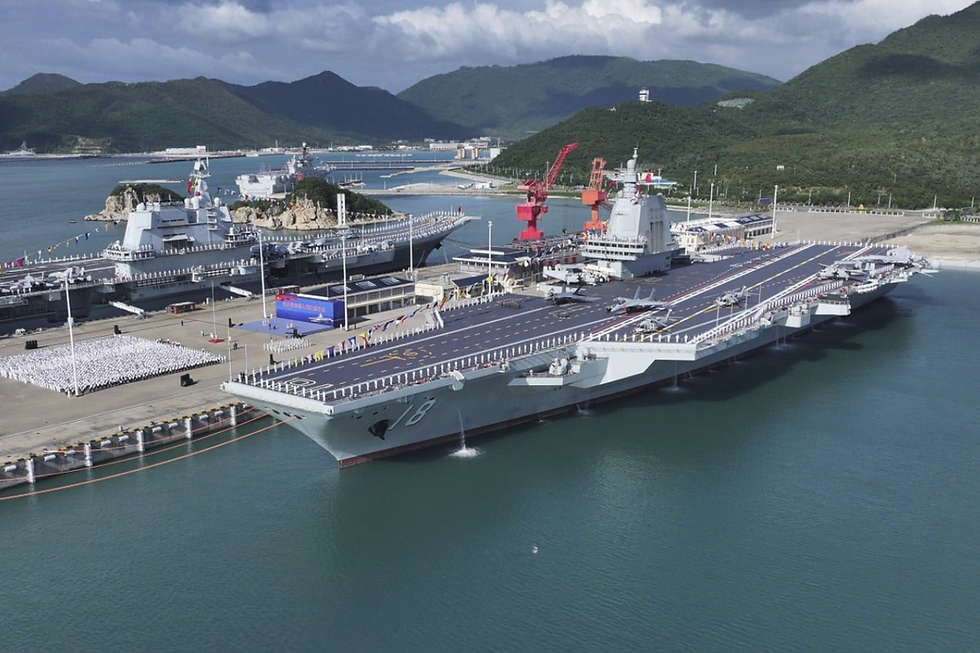
Aircraft Carrier Fujian docked at Sanya, Hainan Province (via the South China Morning Post)
Aircraft Carrier Debut: The People’s Liberation Army Navy commissioned the aircraft carrier Fujian into service on November 7th, with President Xi Jinping attending the inauguration service at a military port in Sanya, Hainan Province, near the Gulf of Tonkin bordering Vietnam. The Chinese state media reported that the aircraft carrier is carrying electromagnetic catapults with the ability to launch aircraft with heavier fuel and weapon payloads. Its service marked the third aircraft carrier debuting under the PLAN and the first indigenously designed carrier.
Competition with the US Navy: The type 003 aircraft carrier's debut comes after President Trump signed an executive order on Maritime industry revitalization in April that would focus on boosting U.S. shipbuilding and maritime industries. This would address ongoing concerns about the U.S. falling behind China. Last month, President Trump announced on the USS George Washington docked in Yokosuka, Japan, that he would sign an executive order directing the United States Navy to use steam for its aircraft carrier’s catapults and hydraulics for the ship’s elevators in a speech with newly inaugurated Prime Minister Sanae Takaichi. Both leaders also reaffirmed the US-Japan military alliance on this occasion.
Larger Impact on the Indo-Pacific: Although the type 003 Fujian Aircraft Carrier is powered by conventional fuel, which requires the ship to make a port call or be met by a tanker at sea to refuel, this contrasts with the nuclear-powered U.S. carriers that can remain at sea for extended periods of time. Under President Xi Jinping, the PLA and its navy have been aggressively expanding as China’s wartime ships have made appearancesin places like the Taiwan Strait, the South China Sea, and even as far as Australia. These frequent incidents have been testing the US resolve and commitment in the Indo-Pacific and whether it will deliver on promises outlines in various security agreements relevant to the region.


Comments