November 20th, 2025

Overview
This week, we discuss trade talks between Germany and China, and recent remarks by Japan's Prime Minister.
Trade
German Leaders to Meet with China on Trade Concerns
By Contributor Deep Basu
Finance Minister & Vice Chancellor of Germany Lars Klingbeil to head trade talks with China on Monday after prolonged delay.
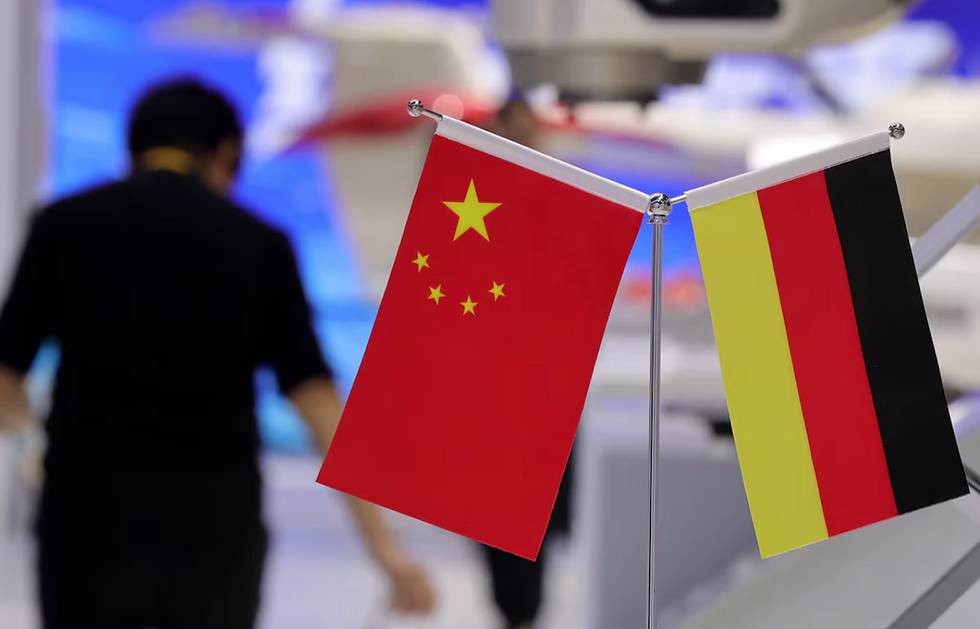
China and Germany National flags together while a person walks behind at the the 8th China International Import Expo (CIIE) in Shanghai, China, November 5, 2025. (via Reuters)
First Direct Meeting: Germany’s Vice Chancellor and Finance Minister Lars Klingbeil will be heading to China on Monday to have high level talks as part of their financial bilateral agreement held every two years. Less than 6 months since Germany’s new government formed a coalition, it has yet to form its own China strategy towards reducing risks and dependencies on China, however little progress has been made.
Casualty of Trade: As a member of the European Union, Germany has been a casualty with Trump’s massive tariffs in his trade war with the rest of the world, leaving them dependent on Chinese imports. The meeting will be with Vice Premier He Lifeng as it comes at a tightening moment where China controls rare earth materials and are limiting their exports to other countries. This exposes a deep flaw where Germany is reliant on China for all aspects and faces calls of criticism back at home.
Widening Trade Deficit: Over the course of 8 months, China became Germany’s largest trading partner, however it faces more than 87 billion euros in a trade deficit with China as a result of this increased trade. Many German officials are concerned about the overproduction of Chinese goods in certain sectors like electric cars and other minerals that threaten homegrowth along with other projects. Germany is still reaffirming the EU guideline of seeing China as a partner, competitor, and interest group as it seeks to lower the playing field, but whether it would pave the way for stabilized talks with other European nations is yet to be seen.
Diplomacy
War of Words: Japanese PM’s Remarks Stoke Chinese Outrage
By Contributor Jason Holman
On November 7th, Japanese Prime Minister Sanae Takaichi’s comments on Taiwan sparked Chinese outrage.

Japanese Prime Minister Sanae Takaichi at her first policy speech in Tokyo on Oct. 24. (via. Reuters)
Survival-Threatening: On Nov. 7, Japanese PM Sanae Takaichi called a potential Chinese invasion of Taiwan a “survival-threatening situation” for Japan, which would require a military response from Tokyo. “Survival-threatening situation” is a legal term relating to a controversial 2015 law that sharply expanded the capabilities of Japan to use its military. This sparked condemnations of Takaichi from Chinese state media such as CCTV, Yuyuan Tantian, and People’s Daily, stating that Japan was interfering in Chinese internal affairs. The strongest response came from the Chinese consul in Osaka, Xue Jian, who posted on X saying, “The dirty neck that sticks itself in must be cut off.” The post was later deleted. However, Chinese officials have refused to apologize for the statement, and Japanese and Taiwanese statesmen have called for the removal of Xue Jian. China has advised citizens to avoid visiting Japan in response.
Taiwan & Japan: China views Taiwan as a breakaway province that is an integral part of Chinese territory. Many countries, like Japan and the US, pursue a policy of "strategic ambiguity” regarding Taiwanese relations, engaging with the government without recognizing Taiwan. When countries violate this ambiguity, it often causes diplomatic disputes with China, as occurred with previous Japanese PM Taro Aso in 2021 over comments about defending Taiwan. Takaichi has been a prominent supporter of Taiwan, often visiting the nation as a lawmaker as recently as April 2025. When she met with Xi on Oct. 31, she met with Taiwanese representatives the next day, sparking uproar in Beijing.
Militarism & Nationalism: Besides Taiwan, militarism and nationalism play a large part in the China-Japan dispute. China and Japan often have rockier relations due to the atrocities committed by the Japanese during WW2 and a lack of Japanese reparations. During this dispute, some Chinese officials have compared Japanese intervention in Taiwan to their 1931 rhetoric on invading Manchuria. Takaichi was a mentee of Shinzo Abe, who sparked similar tensions with China due to his rhetoric. Takaichi seemingly looks to follow in these footsteps, with plans to raise Japan’s defence spending to 2% of the GDP. There will likely be a continued deterioration of China-Japan relations as a result.


Comments