October 5, 2026

Overview
Domestic
China's University Reforms
By Contributor Lily Rabb
Earlier this week, China issued new guidelines for higher education. The document has outlined that each university will be required to specialize in one of the following core missions: research, applied education or skill-oriented institutions.
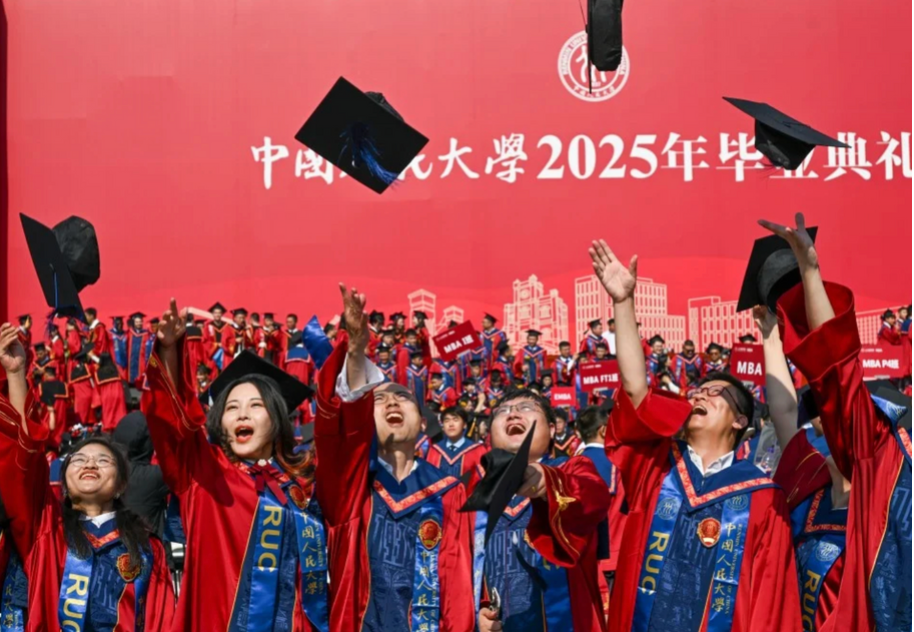
Class of 2025 Chinese university graduates at their graduation celebration (via. South China Morning Post)
Overview: On September 20th, China's Communist Party Central Committee as well as the State Council, issued guidelines for higher education reform. The document specifically stated that universities must adapt to ‘changing trends in the school age population’. And calls to replace the one-size-fits all model with each university being classified by a core mission - research, applied education or skills-oriented institutions, with funding tailored accordingly. Currently, the nationwide enrollment rate for higher education has almost doubled in ten years, from 30% to 60%. A ministry official stated that as the number increases, the system cannot operate on a single track, and thus must seek reform.
Breakdown of the New Process: Universities that specialize in research will be the main collector of funds. They are the ones training the nation's next top innovators, and advancing China's scientific and technological self-reliance. Next, applied universities' main purpose would be on regional development, to close the gap between talent supply and industry demand. Finally, skills - oriented universities would cultivate artisans and technicians based on economic needs. The Gaokao (standardized test all high school seniors take) which determines the university students attend, will also see changes. The main one is that the test will be split into two modes, where students can choose to take a technical based exam or a traditional academic exam. There is a stronger push for the technical skills based exam, as jobs such as engineers, mechanics and biochemists are greatly needed.
Looking Back: This reform is in conjunction with a previous one from the summer, in which over 12,000 undergraduate programs were cut and the introduction of 10,000 new ones were introduced, mainly in AI/emerging technologies. This shift is driven by rising youth unemployment, with officials stating that they want to eliminate programs that do not have direct streamlines into jobs. However, humanities and arts majors are disproportionately reduced, suggesting universities are becoming more and more aligned with the country’s national goals.
One Final Note: In the US, universities are also cutting programs. However, this differs from China, as programs are cut on a financial basis, with a relatively high level of institutional autonomy. This comparison proves how deeply intertwined the Chinese government is with higher education. China’s strategy is direct proof of how it is pursuing its national/security goals of self-reliance. The control the CCP has over the population is demonstrated further, as China prioritizes a harmonious society, and thus the instability in neighboring countries like Taiwan, Myanmar, Ukraine, and Palestine means that lots of unemployed, young students could mean trouble and be destabilizing to the government. Thus a push for higher employment rates is an effective way to secure loyalty and stability within the country.
Military
Havoc at Sea: Chinese Coast Guard Blocks Philippine Mission
By Contributor Donald Webster

China Coast Guard Ship Seen from Indonesian Naval Vessel (via Rand)
Havoc at Sea: This past week, in the backdrop of the Trump-Xi summit Chinese Coast Guard ships blocked a Philippine Coast Guard mission to resupply troops stationed on the Second-Thomas Shoal. The Philippines Coast Guard (PCG) has accused the Chinese of conducting “dangerous maneuvers” directed at its ships, putting their personnel at risk. This marks the first time since 2024 that Chinese Naval Vessels have directly engaged in hostility towards Philippine vessels.
Flashpoint: The South China Sea has been a flashpoint in relations between China and the Philippines as overlapping territorial claims have caused massive disputes. China claims sovereignty over the region due to the nine-dash-line. While the Philippines calls upon the legal precedent set by the Hague in 2016, concluding that China’s ‘nine-dash line’ had no legal merit. The United States has historically backed the Philippines conducting Naval Missions and patrols in the region following the United Nations Law of the Sea. Several features, such as the Second Thomas Shoal, have been claimed by the two countries hoping to use it as a Naval base to project sovereignty over the surrounding area. Currently, the Philippines has a grounded WWII era landing craft stationed on the Shoal with troops stationed at all times.
Encroachment: China and the Philippines signed an agreement in 2024 to allow the Philippines to resupply troops at the Second Thomas Shoal. However, the open attack brings the validity of the agreement into question. It must be asked if this will be the start of renewed friction between the two countries. Another question is whether the United States will choose to support the Philippines as it has done in the past. In 2025, Trump's meeting with Philippine President Marcos focused on trade rather than security. It is yet to be determined if this will result in an escalation of conflict in the South China sea, however it does show a continued pursuit of control of the South China Sea from China.
Diplomacy
Giant Pandas Rerturn to Atlanta as China-U.S. Conservation Cooperation Resumes
By Contributor Jamie Liu
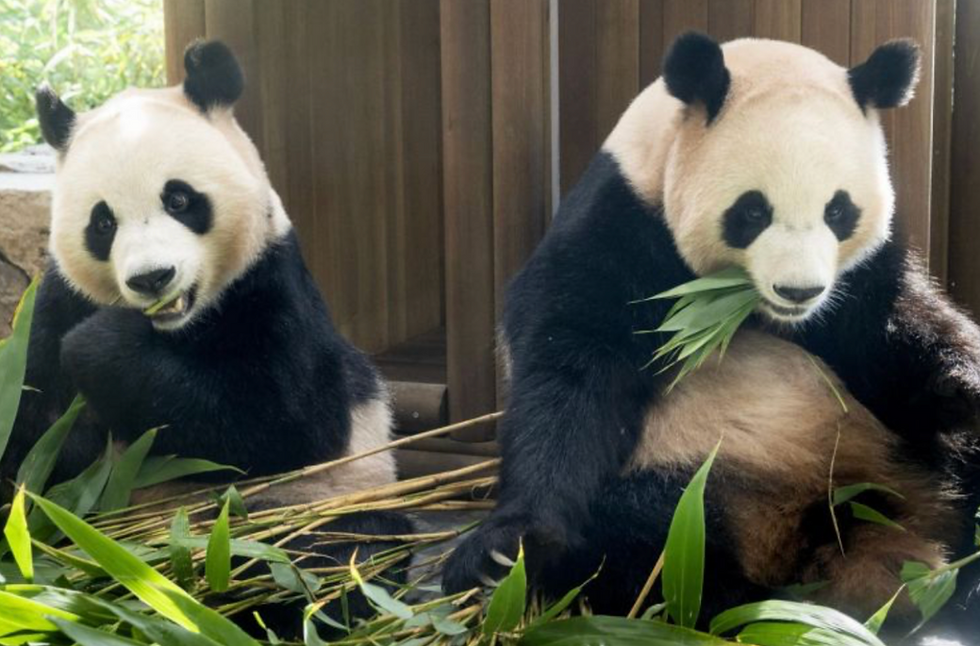
Panda Ping Ping and Fu Shuang(Via.TheAsiaBuisnessDaily )
Zoo Atlanta: Two giant pandas, Ping Ping and Fu Shuang, arrived in Atlanta on September 27 and officially moved into Zoo Atlanta. Both pandas were born at the Chengdu Research Base of Giant Panda Breeding. Ping Ping is male, while Fu Shuang is female. They will live in the United States under a new international giant panda conservation and research cooperation agreement. After their arrival, they will undergo approximately one month of quarantine before making their public debut. This cooperation also makes Zoo Atlanta one of only three zoos in the United States currently housing giant pandas.
Panda Diplomacy: The timing of the pandas’ arrival in the United States also carries diplomatic significance. During his state visit to the United States, Chinese President Xi Jinping publicly announced that Ping Ping and Fu Shuang would arrive in Atlanta within a few days. He described giant pandas as “envoys of friendship” between the Chinese and American people. China has long used international giant panda cooperation programs to promote cultural exchange and conservation cooperation, a practice often referred to as “panda diplomacy.” Therefore, the return of giant pandas to Atlanta is not only a conservation project, but also a symbol of continued people-to-people exchange and goodwill at a time when China-U.S. relations remain politically tense.
Cooperation: Zoo Atlanta has a long history of cooperation with China on giant panda conservation. The zoo began hosting giant pandas in 1999, and the previous round of cooperation ended in 2024, when four pandas returned to China. The new agreement will restart cooperation between the two sides. In addition to bringing giant pandas back to Atlanta, the partnership will continue work on habitat protection, nature reserve management, research, and professional animal care. For China-U.S. relations, giant pandas cannot directly solve disputes over trade, security, or geopolitics, but this kind of highly visible cultural and conservation exchange can still provide a relatively low-risk area for cooperation.
Domestic Affairs
China's Offshore Tax Crackdown: Why now?
By Contributor Peter Huang
In July 2026, China’s State Taxation Administration issued new rules on the individual income taxation of offshore trusts, tightening the enforcement of taxes on overseas wealth. This new move can be attributed to China’s mounting fiscal pressures, and the government’s effort to close longstanding gaps between tax obligations on paper and taxes actually collected.

Shanghai’s Business District and a Straight View of the Oriental Pearl Tower (via. Financial Times)
Not a New Tax but New Enforcement: China’s July 2026 offshore-trust rules do not introduce a new headline tax rate. Under China’s existing Individual Income Tax Law, tax residents are already liable for income earned both inside and outside China. Personal income, including wages and salaries, is taxed progressively from 3% to 45%, while interest, dividends, and property-transfer are generally subject to a 20% rate. The new rules instead focus on how these existing tax obligations apply to offshore trusts, a term referring to a legal arrangement where one transfers assets to a trustee managed under the laws of a foreign country. The July rule clarifies transferring assets to offshore trusts constitutes property-transfer income, therefore subject to the existing rule of 20% rate. The State Taxation Administration explicitly described the rules as intended to strengthen individual-income-tax collection for offshore trusts, and established specific requirements for residents placing assets into such trusts and receiving trust-generated income.
Why Fill the Loophole Now: The timing of the crackdown appears closely tied to China’s worsening fiscal positions. Government revenue, which heavily relies on taxation, fell 1.7% in 2025. More importantly, the prolonged real-estate market downturn has sharply reduced a major source of local government income. According to Financial Times, land sale income fell from RMB 8.7 trillion in 2021 to 4.15 trillion. UC San Diego political economy professor Victor Shih therefore described the July rule as clearly driven by fiscal considerations. Meanwhile, China faces growing capital outflows: the institute of International Finance estimates that Chinese households, companies and financial institutions moved roughly $807 billion last year. The July rule, therefore, serves a dual purpose: recovering previously under-collected revenue due to fiscal pressure while tightening scrutiny over wealth moving overseas.
Consequence for the Wealthy: The crackdown is already forcing the rich to consider how they hold and even where they hold their wealth. Haidilao co-founder Shu Ping recently sold 259 million shares worth HK$2.75 billion as her family faced an unexpected tax bill. Cross-border legal expert David Lesperance suggests that at least 6 of his ultra-high net worth clients have formally begun their emigration plan this year. Yet moving abroad may not end the tax liability. DW, citing the Financial Times, also notes the uncertainty surrounding who remains subject to Chinese taxation, reporting that some Chinese nationals spending fewer than 183 days a year in China may still be treated as tax residents.
Diplomacy
China's Space Station Opens its Doors to Pakistan
By Contributor Andrea

Cooperation agreement between SUPACRO and CMSA on Feb. 28 2025 (via Xinhua)
Tiangong’s first foreign astronaut: China is preparing to send its first foreign astronaut to the Tiangong space station. Two Pakistani pilots, Zeeshan Ali and Khurram Daud, are currently undergoing training in China, receiving Chinese-language instruction alongside preparation for microgravity and the intense g-forces of launch. One will eventually be selected for the mission, serving as a payload specialist and conducting Pakistan’s biotechnology experiments developed to combat food insecurity and climate change. The programme was formalised in February 2025, when Pakistan’s Space and Upper Atmosphere Research Commission (SUPARCO) and China Manned Space Agency (CMSA) signed a cooperation on the joint mission operated by Beijing.
Pakistan as a key space partner: The astronaut program is the latest development in a rapidly expanding Pakistan-China space relationship. Pakistan joined China’s International Lunar Research Station project in 2023, while a Pakistani CubeSat traveled to the Moon aboard China’s Chang’e-6 mission in 2024. Scheduled for 2028, the Chang’e-8 mission will also incorporate Pakistan’s developing lunar rover. The cooperation reflects a partnership between the two countries in which China provides launch infrastructure and technical expertise that Pakistan does not currently possess independently. Pakistani experiments for the Tiangong mission are being generated and tested through SUPARCO before getting signed off by Chinese engineers, providing Pakistani researchers an opportunity to contribute their work into an international space programme.
An alternative international space network?: The Pakistani astronaut also aligns with China’s broader effort to internationalise its independently operated space infrastructure. China has been excluded from direct NASA cooperation since a 2011 U.S. congressional restriction. Rather than remaining isolated, China has increasingly used its own space initiative to cultivate partnerships with territories beyond the mainland. At the China’s State Council Information Office’s press briefing, deputy chief designer Yang Liwei claims that CSMA will be expecting more participants “from mainland, Hong Kong, and Macao.” For Beijing, international access to Tiangong creates opportunities for foreign researchers to participate in Chinese-led missions and strengthens relationships with countries that view China as an important partner in entering space.
Military
Taiwan to Increase Anti-Ship Missile Production
By Contributor Brendan Waldron

A Taiwanese ship launches a U.S.-made missile during live exercises, July, 2022 (via JT)
The News: Taiwan's Ministry of National Defense announced a new $700 million initiative aimed at procuring up to 200 new and improved Hsiung Feng anti-ship missiles. The missiles are instrumental to Taiwan’s defense strategy as any attack from China would inevitably involve a large-scale amphibious assault, and long range anti-ship missiles are the first line of defense. The Hsiung Feng II & Hsiung Feng III versions are complete with advanced microchips which allow them to filter through electronic interference, creating a higher chance of a successful hit which is crucial when each ship could take multiple hits to eliminate.
What this Means for Taiwan: The new purchase is in addition to the broader Sea-Air Combat Power Improvement Plan, which already adds 1,400 new missiles. Just this past September, Taiwan sunk a decommissioned frigate using one of the Hsiung Feng III missiles, showcasing the devastating power they possess. Taiwan’s missile and overall domestic defense production has rapidly increased in recent years, partly as a result of decreasing confidence in U.S. aid. As over $30 billion in military aid has been stalled by the U.S. in recent years as they walk the tight rope that is relations with China, Taiwan has proposed a $35 billion defense budget - the largest in its history.
Future of Warfare: Taiwan is taking a proactive approach to deterrence towards China and taking into account all of the lessons learned from both the Ukraine war, and Iran war which are both ongoing. The conflicts have proven how important autonomous aerial and sea drone systems can be, and as a result Taiwan has signed contracts with Saronic, Anduril, Shield AI, and various other autonomous weapons system companies. Anduril, for example, produces a large variety of weapons from miniature planes, boats, or submarines - all of which would be incredibly valuable in the event of a war breaking out between Taiwan and China. These small drones pack an explosive punch and are incredibly difficult to target when used in swarms for larger naval vessels or defense systems, and prove to be highly cost effective as well. Hopefully they will never be put to the test, but if needed, Taiwan's proactive measures could be game changers.
Society & Culture
The 2026 Asian Games Conclude!
By Contributor Skye Early
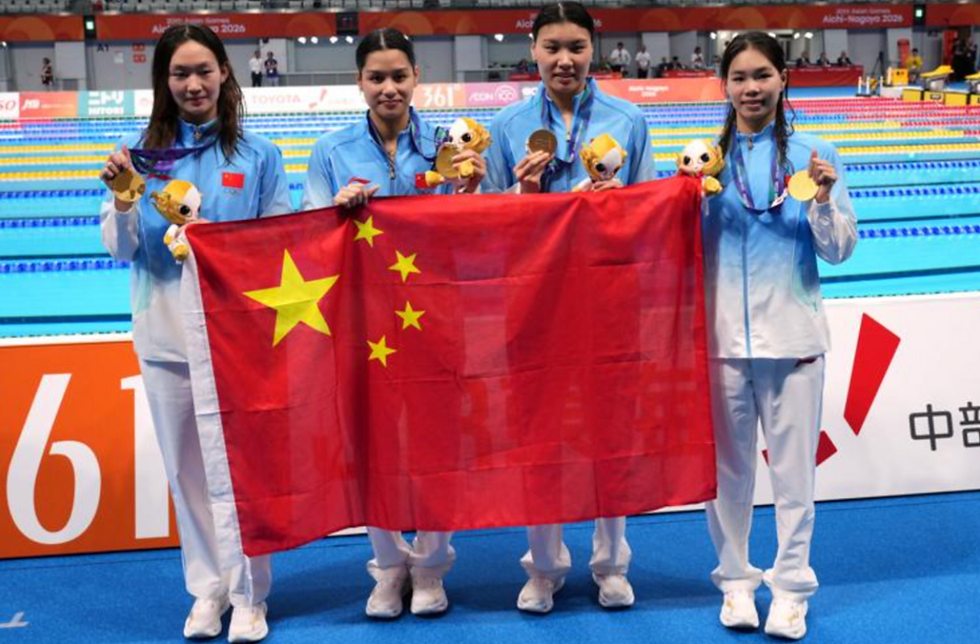
Chinese athletes at the Asian Games (via The Free Press)
Background: The Asian Games are an Olympic-like sporting event where multiple sporting competitions take place, and different countries across Asia compete together to win the most medals; they take place every 4 years. This year, they took place in Nagoya, Japan, and hosted at least 11,000 athletes from the continent. There were 43 sporting events that were on display, 5 being Asian oriented sports: Kabaddi, Karate, Sepaktakraw, Wushu, and Taekwondo, and the event is sponsored by over 60 companies, the biggest one being Toyota. The event concluded on October 4th.
Past Recent Winners: The 2022 Asian Games were postponed to October of 2023 in Hangzhou, China. China, Japan, and Korea were the most dominant countries (& historically do well). China won 383 medals total,Korea won 190, and Japan won 188 medals.
2026 Results: The People's Republic of China dominated in first place with 341 medals: 169 gold, 89 silver, and 83 bronze medals. They also held the top 10 athletes with the most medals. In second place is the host of the event, Japan, with a total of 269 medals: 83 gold, 95 silver, and 91 bronze medals. In third place, with a total of 150 medals, stands South Korea; they received 39 gold, 43 silver, and 68 bronze medals. Other major wins include the Indian men's and women's kabaddi teams securing gold medals against Iranian competitors. Malaysia and Thailand won 3 medals in Esports, and Bahrain’s Yavi Winfred tied with 10 other Chinese competitors for 13th place for best athlete with 3 gold medals in athletics. India dominated in both women's and men’s archery events, including 2 gold medals per delegate from India. South Korea dominated baseball and outperformed Japan and Kazakhstan, and has won 3 gold and 1 silver medal in cycling. Abdulmalik Hajar brought 2 bronze medals to Kuwait in women’s shooting events. Pereira Shanti brought home a gold and a silver medal for Singapore in athletics. 350 Asian records were broken, and 50 included World Records. 13-year-old Yu Zidi of the People's Republic of China made second place in Top 5 performances for Women’s 200 IM (LCM) with a 2:06.10 minute time. Filipino delegate EJ Obiena set a new Asian Games record in the men's pole vault by clearing 5.91 m. Mariam Kareem, representing the UAE, broke the Games record in the women's 400m Hurdles with a 54.31-second time. Indonesian weightlifter Rahmat Erwin established a new world record in the 75-kg class after recording a total lift of 366 kilograms.


Comments