October 6th, 2025
- USCSSO @GWU
- May 17
- 5 min read

Overview
This week, we discuss the growth of AI, China's southern border, and soybean exports.
Economics
As AI drives growth in the U.S. and China, concerns of a bubble rise
By Contributor Aben Bhattachan
Many currently fear that AI-driven growth seen in the tech companies of the U.S. and China is unwarranted and unsustainable.
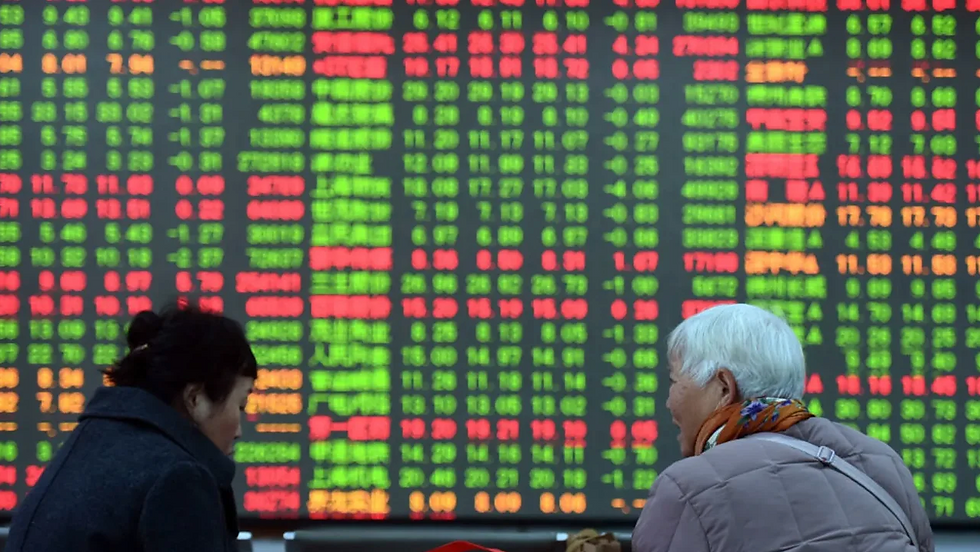
Investors talk at a stock exchange hall on February 3, 2017 in Hangzhou, Zhejiang Province of China. (via CNBC)
U.S. Phenomenon: The Magnificent Seven (Alphabet, Amazon, Apple, Meta, Microsoft, Nvidia, and Tesla) stocks currently make up a third of the S&P 500, controlling a significant portion of the market’s movement. Their growth has been increasingly connected to AI, as their swings in prices are now largely driven by investment and excitement around AI. Thus, some analysts believe a bubble is forming in the U.S. due to the scaling limits of Large Language Models (LLMs). Task-completion rates for LLMs at some companies have become inconsistent, and there is a growing concern over the relationship between costs and performance for LLMs. The costs of ChatGPT from versions 3 to 5 have increased a hundredfold ($50 million to $5 billion), while performance is viewed to have stalled by some.
China’s Parallel: A similar trend is developing in China. Tech stocks, such as Alibaba, Baidu, Tencent, and Xiaomi, have all outperformed Nvidia this year in percentage gained. Their AI-driven bullish run has also given them control over the Chinese market, as Tencent, Alibaba, and Xiaomi currently comprise 30% of the Chinese index. This represents a shift in Chinese stock performance from previous years, reversing historically poor performances. Kickstarted by DeepSeek’s first AI model release, Chinese companies and their government have invested heavily in AI development. However, China’s high-performing stocks contrast with its ongoing economic slowdown, as retail sales and industrial output growth slow. Going against economic fundamentals means that some believe in stock growth currently being too optimistic in comparison to earnings, with a market pullback possible.
Past Precedence: Many comparisons can be drawn between the potential AI bubble and the dot-com bubble. For both eras, large increases in investment rates by companies represent unstable growth that is bound to end at some point. Powell’s comments on current stock prices, such as “Equity prices are fairly highly valued,” are a flashback to the perceived reasonability of the dot-com companies' growth, as financial crises tend to occur unexpectedly. However, there are some signs of resilience. Both the Magnificent Seven and Chinese tech companies still profit from their non-AI ventures, and are not debt-financed as the dot-com companies were.
Defense
Trading Fire and Fear: China’s uneasy Southern Border
By Edward Lee
As criminal activity ramps up along the Southwestern border with Myanmar, Chinese authorities work to contain the issue, with recent prosecutions showing transnational links.

Fading Luxury: Following the February 2021 coup d'état, in which a military Junta seized control of Myanmar from the preexisting democratic government, the country has devolved into civil war, with government forces battling insurgent groups throughout the country, specifically along the northern and western border regions. This instability has emboldened Myanmar's triad networks, which are involved in numerous drug, human trafficking, and illicit casino operations. Additionally, many triads maintain strong relations with Chinese organized crime groups, who facilitate cross-border smuggling operations. Recent degradations of the security situation have given criminal elements more freedom of movement, leading to an increase in slave labor schemes targeting Chinese citizens.
Chinese Response: With the growing threat of transnational criminal syndicates on its border, Chinese authorities have increased their security posture in border regions. Over the past year, border garrisons have been observed participating in large-scale live-fire exercises, with a particular focus on air-to-ground interdiction. Additionally, Chinese authorities have stepped up investigatory actions against Myanmar-based groups, with a Wenzhou court recently sentencing 12 members of the so-called "Ming Family" crime network to death on charges ranging from drug trafficking to telecommunications fraud. China has also shown an increasing propensity to work with other Southeast Asian countries, such as Thailand, Cambodia, and Laos, to counter the growing issue of so-called "slave labor centers", which lure Chinese citizens to work as scam center operators. This has included strengthening border controls in hotspot areas, with individual crossing points often restricting traffic to Chinese citizens exclusively.
Potential for Peace: Recent talks between Myanmar's Junta and Chinese officials have yielded results, including increased border traffic flow; however, the presence of rebel elements hinders any significant changes. Beijing has recently worked to move towards a peace deal in Myanmar, with both diplomatic and economic pressure being applied in an effort to bring pro-democracy rebels to the table with the Junta leadership. While these efforts have yielded notable results, such as a ceasefire in the country's northeastern Kokang region, there is still work to be done before the border returns to normal.
Trade
China is no longer buying U.S soybeans, leaving rural America desperate
By Contributor Deep Basu
U.S. farmers struggle to attract China, their biggest customer for soybean sales, looking for a possible bailout by the Trump administration.

Pictured Above: Soybeans atop U.S.-China flags (via GettyImages)
U.S. Trade War: For the first time in more than 20 years, Chinese importers are no longer buying U.S. soybeans due to the rising cost imposed by the ongoing trade war, leaving farmers scrambling to adjust to the shift. In 2024, American soybean exports brought in more than $30 billion in revenue, according to the U.S Department of Agriculture. The largest importer for U.S. soybeans was China, which bought 45% of American soybeans.
Alternative Customers: The latest shift in foreign trade comes as Argentina lifted its export tax on grains, leading China to buy seven tons of soybeans from the South American nation. This action followed receipt of a $20 billion bailout from the Trump administration, alienating American farmers struggling to sell crops due to low prices. Leaked text messages between Agriculture Secretary Brooke Rollins and Treasury Secretary Scott Bessent revealed discussion of the bailout backfiring as Argentina and China seek closer ties. China has effectively bypassed U.S. farmers, who are already struggling due to retaliatory tariffs imposed by China in response to Trump's tariffs on Chinese imports. This shift in trade dynamics has not only reduced the U.S. market share in China's soybean imports, but has also highlighted the vulnerability of American agricultural exports to trade tensions.
U.S. Farmers' Fate: Many U.S. farmers are desperately seeking other nations to help fill the void left by China, such as Vietnam, Nigeria, and Bangladesh. However, these markets are much smaller and underdeveloped compared to China’s massive demand. The Trump administration responded with a significant bailout program to support affected farmers, with soybean costs rising sharply as trade tensions persist. By June of 2025, farm bankruptcies rose sharply with the U.S. soybean market in a freefall. During the 2019 trade war with China, farmer bailout aid reached over $12 billion, reflecting the deep economic impact of losing China as a key buyer. This financial relief highlights the severity of the trade disruption and the vulnerability of U.S. agriculture to global trade shifts.


Comments