September 26th, 2025
- USCSSO @GWU
- May 17
- 5 min read

Overview
This week, we discuss K-drama controversy, President Xi's speech at the United Nations General Assembly, and a typhoon barreling toward mainland China.
Society & Culture
K-DRAMA: Actress Jun Ji-Hyun Faces Mass Criticism in China
By Contributor Jason Holman
Jun Ji-Hyun is facing massive controversy in China over lines viewed by many as offensive in Disney+’s new show “Tempest”.

Jun Ji-Hyun playing diplomat Seo Mun-Ju in the new Disney+ show “Tempest”. (via Zapzee)
Jun Ji-Hyun: South Korean actress Jun Ji-Hyun’s controversial line, “Why does China prefer war?”, has many Chinese netizens angry, viewing it as characterizing China as a belligerent nation. Chinese audiences have additionally criticized the show’s depictions of the city of Dalian as overly ugly and Ji-Hyun’s reading of a Chinese poem in a wonky Chinese accent. Over 58% Tempest’s reviews on Chinese platform Douban are 1 star. Additionally companies such as La Mer, Louis Vuitton, and Piaget have scrubbed Ji-Hyun from their Chinese social media accounts. EcoVacs, the second largest Chinese vacuum company, which made Ji-Hyun their brand ambassador in 2024 have additionally removed her from their accounts.
Hallyu-Ban: Hallyu or the Korean Wave has faced an ‘unofficial ban’ in China since 2016. The ‘ban’ came as a result of S. Korea’s installation of U.S. Terminal High Altitude Area Defense (THAAD) missile systems near Seoul, which has been viewed by China as a threat due to it’s 2,000 km range. While unofficial, China's National Radio and Television Administration (NRTA) has barred content from Korean companies since 2016 which has cost S. Korea an estimated $16 billion since 2016.
Cultural Security: In the early 2000s Korean culture was very popular in China, with hit successes such as the K-Drama “What is Love?”. There began to be worry in China of “cultural security” and whether Korean culture posed a threat to domestic Chinese film and music industries. This being viewed by some as the reason for China’s decade long Hallyu ban. However, recent Chinese film successes such as Ne Zha 2 and 2024 intentions by S. Korea and China to increase cultural cooperation were seen as hopes that 2025 would be the end of the Hallyu ban. Yet so far the year has been marked by several K-Pop concerts in China being unexpectedly canceled due to ‘local circumstances’. Now the recent Tempest controversy has shown how perhaps that perhaps growing animosity has led Chinese citizens no longer desire S. Korean content.
Climate Change
China Pledges to Cut Emissions by 7-10% by 2035
By Contributor Roane Smith
China announces new climate goals at the United Nations General Assembly, including cutting all greenhouse gas emissions 7-10% by 2035.
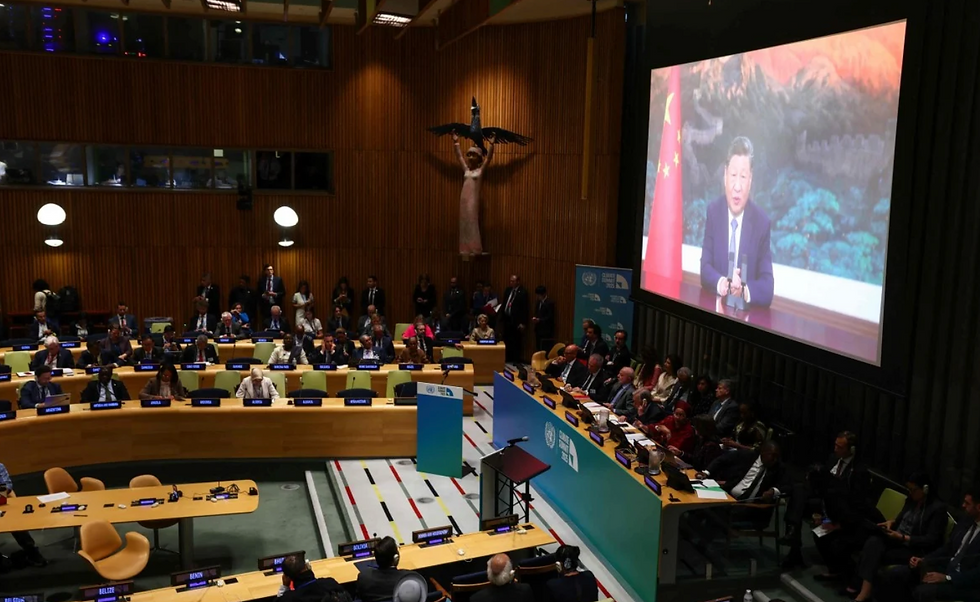
President Xi Jinping addresses the United Nations (via the South China Morning Post)
New Climate Goals: On September 24th, President Xi Jinping announced China’s new climate plans to the United Nations General Assembly. These include cutting all greenhouse gases by 7-10% by 2035, expanding wind and solar power capabilities, and increasing forest stocks. His announcement has drawn critique from those who feel it is underwhelming, with Colombia’s former President Juan Santos stating that “China’s latest climate target is too timid given the country’s extraordinary record on clean energy…China must go further and faster.” However, the announcement has also drawn praise from Brazil’s President Luiz Inácio Lula da Silva and Zhang Weishi from the Tianjin Normal University. Weishi called the new targets “credible” and said they were backed by a thorough policy framework.
Putting Goals in Context: Although China’s new emission targets are groundbreaking individually, they are comparably small when compared to other countries’ proposed climate plans. Australia declared its plan to be 62-70% below 2005 levels by 2035, and the South Pacific island nation of Palau announced its goal to be at 44% of 2015 levels by 2035. However, since China is the largest carbon emitter, responsible for more than 31% of global emissions, even a 10% reduction equates to 1.4bn tons of emissions per year. China also has a history of under promising and overdelivering when it comes to climate change. While they pledged to hit a peak of carbon emissions by 2030, the Climate Action Tracker (CAT) reports that they could reach their peak and begin reducing by this year if things continue as they are. In fact, the CAT stated that this goal will not have any new effect on China’s carbon emissions as their current policies already have them on track to meet these goals.
It's Still Not Enough : The Paris Agreement on climate change set a ceiling for global temperature rise of 1.5o Celsius. While the global temperature has already risen by 1.3o Celsius, the Paris Agreement has successfully cut projected temperature rise from 4o to 2.6o Celsius. However, the BBC reported that most scenarios to keep within the 1.5o limit would require over a 50% reduction in emissions from China. Additionally, the Stockholm Environment Institute also states that with climate plans as they are, the world will collectively produce more than double the emissions needed to retain the 1.5o goal.
Entertainment
Super Typhoon Headed Towards Southeast China
By Newsletter Director Lindsey Spain
The strongest typhoon of the year has descended upon the northern Phillipines, and is on course to hit Hong Kong and mainland China later this week.

Pictured Above: Satellite image of Super Typhoon Ragasa (credit: Severe Weather Europe)
Typhoon Madness: Regaled as the strongest storm anywhere in the world this year, Super Typhoon Ragasa slammed into the northern Philippines on Monday, and is on course to hit Hong Kong and mainland China later this week. The Philippine Atmospheric, Geophysical and Astronomical Services Administration (PAGASA) reported landfall over Panuitan Island, located in Northern Cagayan Province, with sustained winds in excess of 165 miles per hour. Super Typhoon Ragasa saw explosive growth over the weekend due to unusually warm oceanic temperatures in the Western Pacific. It is projected to make landfall in Hong Kong on Tuesday, and in mainland China around Wednesday.
Mainland Impact: Super Typhoon Ragasa is projected to impact mainland China from Shanwei in Guangdong Province, to Wen chang in Hainan Province. In Shenzen, authorities are preparing for the evacuation of nearly 400,000 citizens from coastal and low-lying areas, which are expected to bear the brunt of the storm. Authorities in Guangdong raised the wind emergency response on Monday to Level II, the second-highest in China's four-tier warning system. While Guangdong authorities haven’t published any information regarding evacuation, several schools and businesses across the region will be in recess until the storm passes. All high-speed and regular rail services in Guangdong will be suspended on Wednesday, with schools in Zhuhai and Jiangmen suspending class starting Tuesday.
Economic Implications: Hong Kong International Airport will be proceeding with the suspension of all flights for the next 36 hours, impacting thousands of individuals. This will be the longest suspension of flights ever carried out at Hong Kong’s airport, to begin at 8pm local time on Tuesday and end at 8am Thursday. The airport contributes to 5% of Hong Kong’s GDP, both directly and indirectly, with a flight suspension potentially costing the airport tens of millions of dollars. Additionally, Hong Kong residents are hurriedly rushing the grocery stores to stock up on supplies, with netizens reporting empty shelves devoid of even premium goods. The full extent of the economic impact upon Hong Kong and mainland China is yet unknown, but it is estimated to be in the hundreds of millions of dollars.


Comments